
Stucco Painting in Hayward, CA
House Painting Canyon Hayward covers stucco painting, crack patching and acrylic and elastomeric coatings for Hayward, CA stucco houses, where older 1950s and 1960s stucco is common and the first question is what the cracks are doing.

Bookings aren't open yet. Leave your name and number; your message is recorded, and you'll get one message when a local installer is available.
 Illustration
Acrylic or elastomeric
| Acrylic exterior paint | Elastomeric coating | |
|---|---|---|
| Film | Thin, flexible | Thick, rubbery |
| Hairline cracks | Fills a few, not bridges | Bridges many hairlines |
| Moisture | Breathes more | Can hold moisture behind it if applied over damp stucco |
| Later work | Easy to recoat | Harder to recoat; repairs show |
| Cost | Lower | Higher; about $600 to $2,200 extra on a typical house |
Sound stucco usually takes acrylic. Elastomeric suits stucco with many hairline cracks and water entry, and still needs clean, sound prep underneath.
Cracks and layers on stucco
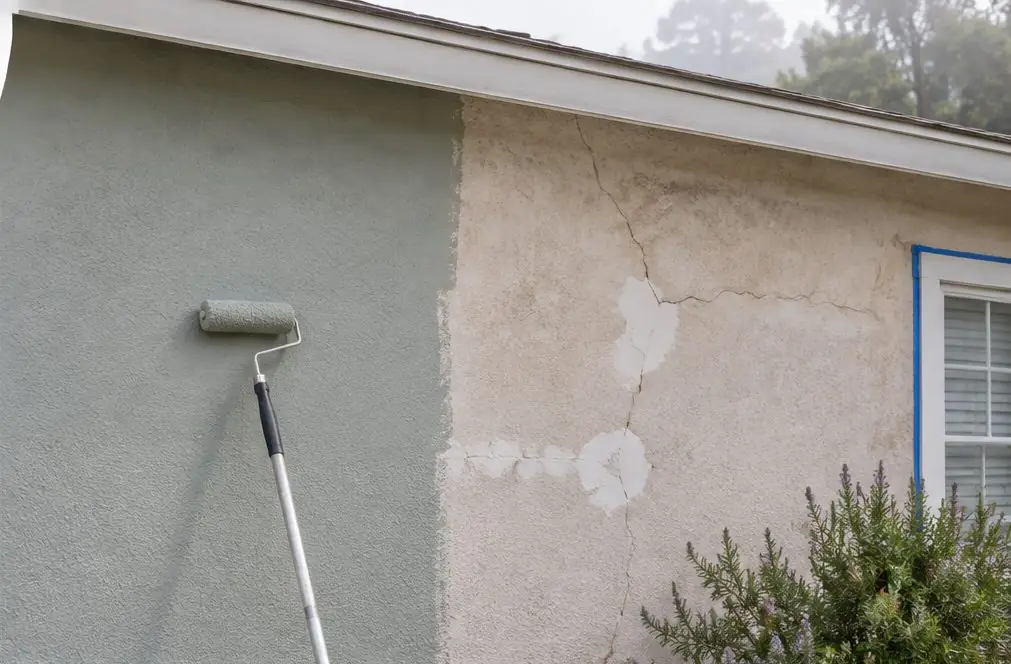
Stucco is a hard cement coat over lath, built in layers, and each layer behaves differently. Hairline cracks, thinner than a credit card edge, come from drying shrinkage and are cosmetic. Wider diagonal cracks at window corners, stair-step cracks and cracks that reopen after patching mean something is moving.
- Mark the crack. Pencil the ends and the date; if it has grown, stop and ask for an inspection.
- Hairline. Brush clean, fill with flexible patch, texture to match, prime.
- Moving crack. Do not paint over it. A general contractor or inspector decides the cause.
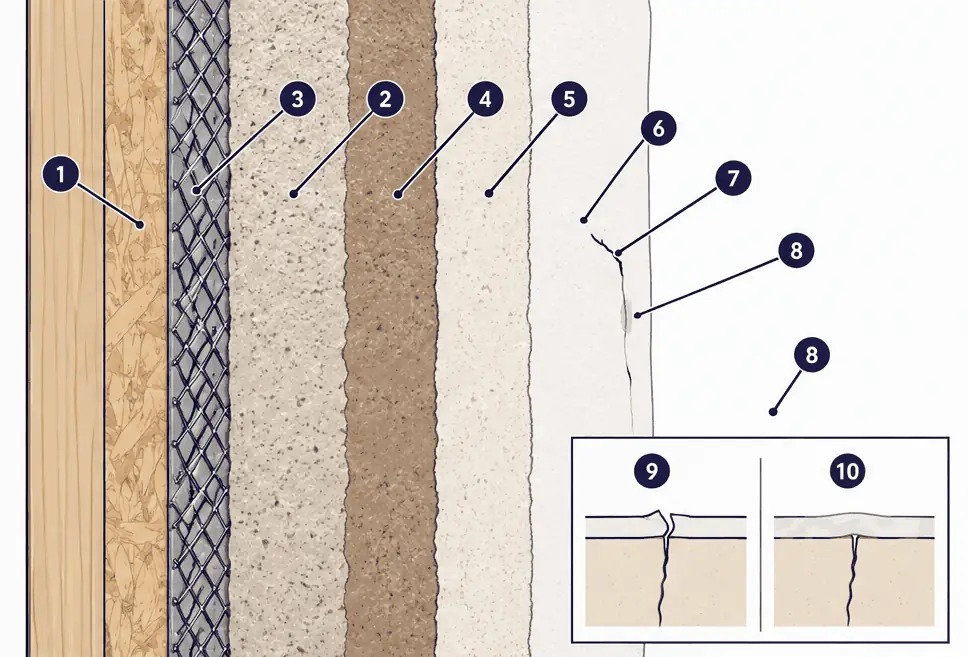
What the numbers show
- Stud and sheathing The wood framing and the board covering it, behind the stucco.
- Scratch coat The first plaster coat, pushed through the lath and scored so the next coat bonds.
- Lath A wire mesh fastened to the framing that gives the first coat something to grip.
- Brown coat The second coat, which builds the wall flat.
- Finish coat The outer coat that gives the wall its texture. It is the surface paint is applied to.
- Hairline crack A thin crack in the finish coat. It shows up first at window corners and other places where the wall is stressed.
- Patch compound A flexible filler pressed into the crack and smoothed flush with the face.
- Primer and paint Primer over the patch, then the finish coats. A crack that keeps moving after it is patched needs an inspection before it is painted again.
- Thin film A standard acrylic film is thin and can split along a crack when the crack opens.
- Thick stretchy film An elastomeric coating is thicker and stretches, so it bridges a hairline crack better; it still needs sound prep underneath.
Preparation that matters on stucco
Stucco is washed with a pressure washer set to avoid driving water into cracks, then left to dry for a day or more. Efflorescence, the white salt crust, is brushed off. Patches are textured to match the old finish, sealed with a masonry primer and then coated. Overspray is a worry on stucco: cars, windows and the neighbor's fence are masked and shielded.
What stucco repainting typically costs in Hayward
For a 1,400-square-foot one-story house, sound paint:
| Work | Per sq ft | 1,400 sq ft |
|---|---|---|
| Acrylic repaint, sound | $4.50–$8.00 | $6,300–$11,200 |
| Peeling areas, extra scraping | $5.00–$9.50 | $7,000–$13,300 |
| Big color change | $4.90–$9.00 | $6,860–$12,600 |
| Pre-1978 house, lead-safe work practices | $5.25–$10.00 | $7,350–$14,000 |
Elastomeric instead of acrylic adds a flat $600 to $2,200, so $6,900 to $13,400 for the sound one-story. A two-story 1,900-square-foot stucco house runs $5.00 to $9.50 per square foot, $9,500 to $18,050, and $10,100 to $20,250 with the elastomeric. Market estimates, not quotes.
Stucco Painting — common questions
Is elastomeric paint better for Hayward stucco?
Only for stucco with many hairline cracks and water entry. On sound stucco acrylic is easier to recoat later. Elastomeric bridges hairline cracks and sheds water better, but it needs sound prep.
Should I paint over a crack in stucco?
A hairline crack is filled and primed first. A wide diagonal crack, a stair-step crack or one that reopens needs an inspection before any paint; an inspection decides what it is.
How much does painting a stucco house cost in Hayward?
Typical ranges are about $4.50 to $8.00 per square foot, so $6,300 to $11,200 for a 1,400-square-foot one-story house. Market estimates, not quotes.
Stucco Painting: check availability and price range
Bookings aren't open yet — a typical Hayward range in about 30 seconds.